Liverpool figures
Liverpool homes and heating: what the Census shows
Two facts shape gas safety in Liverpool more than any other: most homes are heated by mains gas, and more of them are rented than in England as a whole. Here are the Census 2021 figures, and what they mean in practice.
Short answer
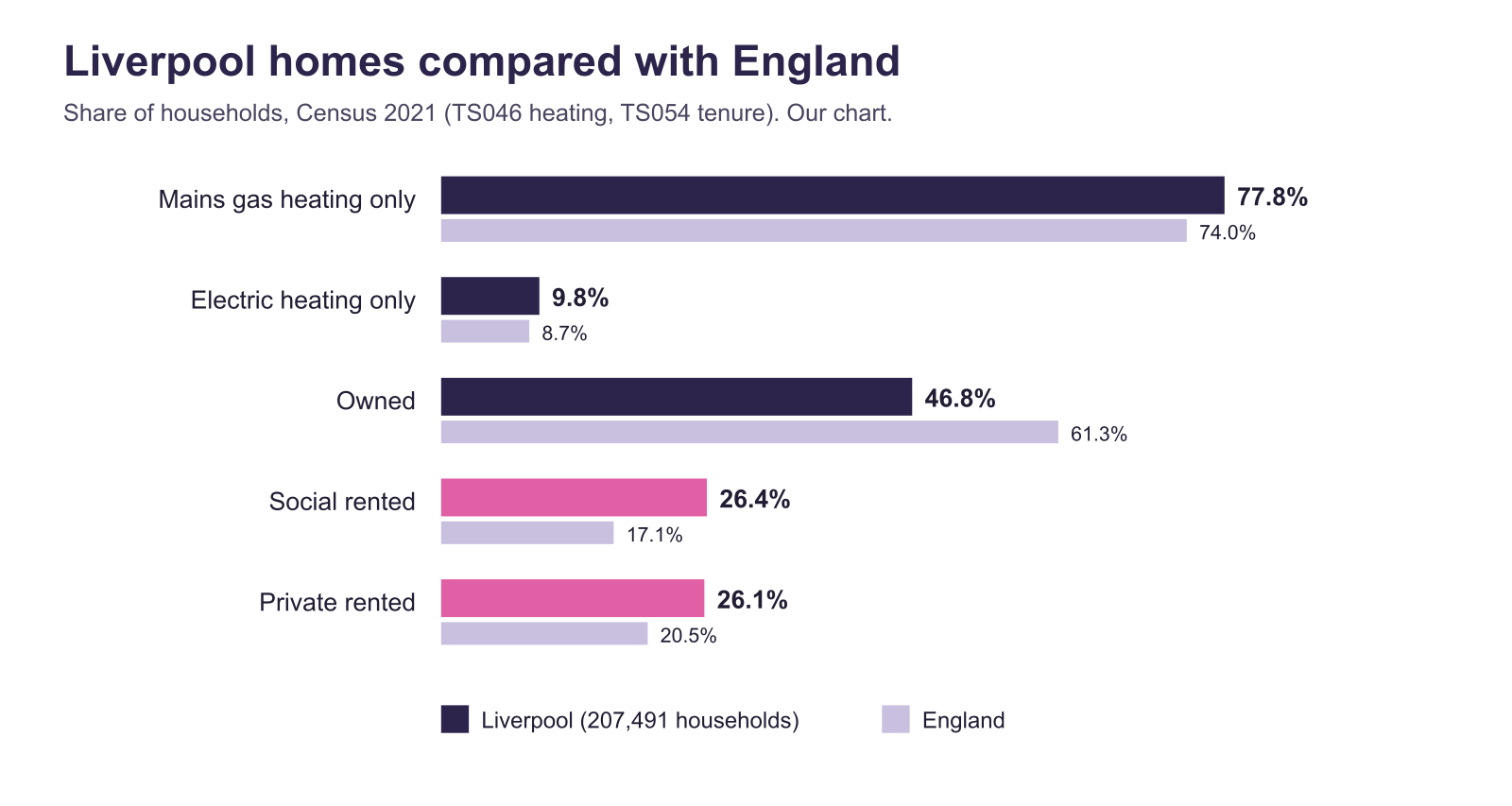
Of Liverpool's 207,491 households in 2021, 77.8% heated with mains gas only (England 74.0%). 26.1% rented privately and 26.4% from a council or housing association (England 20.5% and 17.1%); 46.8% owned their home (England 61.3%). Gas safety checks and landlord duties touch most of the city.
Heating
How Liverpool homes are heated
| Heating | Liverpool | England |
|---|---|---|
| Mains gas only | 77.8% | 74.0% |
| Electric only | 9.8% | 8.7% |
| Oil only | 0.1% | 3.2% |
| Tank or bottled gas only | 0.5% | 1.0% |
| Two or more types | 7.5% | 9.0% |
| No central heating | 2.3% | 1.5% |
Liverpool is more dependent on mains gas than England as a whole, and almost no homes use oil: 0.1% against 3.2% nationally. Electric-only heating is a little more common, at 9.8%. And 2.3% of households had no central heating at all in 2021, above England's 1.5%.
Tenure
Who owns and who rents
| Tenure | Liverpool | England |
|---|---|---|
| Owned | 46.8% | 61.3% |
| Social rented | 26.4% | 17.1% |
| Private rented | 26.1% | 20.5% |
What it means
Renting changes who's responsible
In an owner-occupied home, the owner decides when to service the boiler and who does it. In a rented home, the landlord owns the appliances and carries legal duties: an annual gas safety check on every appliance and flue it provides, copies of the record for tenants, records kept for two years, and, since October 2022, carbon monoxide alarms in rooms with fixed combustion appliances.
With more than half of Liverpool's households renting, those duties apply across most of the city. For tenants, that makes the gas safety record one of the most important documents to have; for landlords, keeping track of check dates matters. See landlord gas safety and tenants' rights.
No central heating
The 2.3% without central heating
About one Liverpool household in 43 had no central heating in 2021. Some heat with individual gas fires or portable heaters, which brings its own risks: gas fires need clear flues and ventilation, and any fuel-burning heater can produce carbon monoxide if it's faulty or the room is poorly ventilated. If that's your home, an annual check of each appliance by an engineer registered for it, and a carbon monoxide alarm, are worth prioritising. See gas fires and flues.
Looking ahead
Gas in Liverpool's future
Gas will heat most Liverpool homes for years yet. There's no confirmed date for phasing out gas boilers in existing homes. New homes are a different matter: the Future Homes Standard requires low-carbon heating and, in most cases, solar panels in new homes in England from 24 March 2027, after a transition. As heat pumps become more common, the question of whether to replace a failed gas boiler like for like will come up more often. See gas boiler or heat pump.
About the figures
Where these numbers come from
All figures are from the Census of March 2021, published by the Office for National Statistics and read through Nomis, tables TS046 (central heating) and TS054 (tenure), for the Liverpool local authority area and for England. They describe households, not buildings. Things will have moved on from the 2021 Census, with more heat pumps and some changes in tenure, but the broad picture of a gas-heated city with a large rented sector still holds. We'll update this page when newer official figures are published.
We use these numbers to decide what this guide covers, not to make claims about any individual home. For your own home, the gas safety record, service history and the advice of a Gas Safe registered engineer are what count.
For households
What to do with this
If you own a gas-heated Liverpool home, the annual service HSE advises is the routine that matters most. If you rent, make sure you have a current gas safety record and a working carbon monoxide alarm in any room with a boiler or gas fire. If you let property, plan your checks so none slip past the 12-month deadline, using the two-month window where it helps. If you're thinking about a heat pump, start with an MCS certified installer's survey. None of these is complicated, and together they cover most of what keeps a gas-heated home safe. See checking an engineer and carbon monoxide safety.
Electric and mixed heating
The one in ten on electric heating
9.8% of Liverpool households heated with electricity only in 2021, a little above England's 8.7%, and 7.5% used two or more types of heating. Electric heating needs no gas engineer, but many of these homes still have a gas cooker or a gas supply to a fire. Any gas appliance in the home, however rarely used, needs a registered engineer for work on it and, if the home is let, must be included in the annual check.
Homes with mixed heating, for example a gas boiler and a wood-burner, need both kinds of appliance looked after by someone competent for each, and carbon monoxide alarms where the rules or common sense call for them.
If you'd like to explore the figures yourself, Nomis lets anyone look up Census 2021 tables for Liverpool and compare them with other areas, free of charge. The tables we used are TS046 for central heating and TS054 for tenure.
We'll refresh these figures when newer official data is published.
Sources used on this page
- Census 2021 TS046, central heating, Liverpool and England · Nomis (3 November 2026)
- Census 2021 TS054, tenure, Liverpool and England · Nomis (3 November 2026)
- Landlords’ responsibility for gas safety · HSE (3 November 2026)
- Smoke and Carbon Monoxide Alarm (Amendment) Regulations 2022: guidance · GOV.UK (3 November 2026)
- Future Homes and Buildings Standards: consultation response, March 2026 · GOV.UK (PDF) (2 November 2026)
A question about gas work in your home?
Tell us what you're trying to sort out. Your message reaches SEO-DONS LTD, the publisher of this guide, and we answer by email. We don't do gas work or recommend engineers, but we can tell you what to check and where. If you smell gas, don't write to us: call 0800 111 999 now.
What happens next
- Your message reaches SEO-DONS LTD, which publishes this guide.
- We reply by email with the rule or check that applies.
- Any work is between you and a Gas Safe registered engineer you choose.