Emergency
Smell gas in Liverpool? What to do straight away
If you can smell gas now, stop reading after the first steps below and act. The rest of this page explains what happens next, and what to do once the immediate danger has passed.
Short answer
Call the gas emergency number, 0800 111 999. Open all doors and windows. Shut off the gas supply at the meter control valve if you know where it is. Don't use any gas appliance you suspect is unsafe. If anyone feels unwell, get them into fresh air and seek urgent medical advice.
Right now
The three steps HSE gives
- Call 0800 111 999. This is the national gas emergency number, free from landlines and mobiles. Tell them where you are and what you can smell.
- Open all doors and windows to let the gas disperse.
- Shut off the supply at the meter control valve, if you know where it is. It's usually a lever near the gas meter; turning it so it sits across the pipe closes it.
Commonly given advice from the gas emergency service also includes not using light switches or anything that could cause a spark, not smoking or using naked flames, and leaving the property if the smell is strong. Follow what the call handler tells you.
HSE is clear that it is illegal for anyone to use a gas appliance they suspect is unsafe, so don't turn the boiler or cooker back on to "test" it.
What happens next
When the emergency engineer arrives
The gas emergency service's job is to make the situation safe. Its engineer will look for the source of the leak and may cap off an appliance or turn off the supply to part or all of the property. If an appliance is found to be dangerous, it will be labelled not to be used.
The emergency service doesn't usually repair your boiler, cooker or fire. Once the property is safe, you'll need a Gas Safe registered engineer qualified for that appliance to repair or replace it, and in the meantime the appliance must not be used. Ask the emergency engineer to explain what they found and leave you a note of it; the engineer you book next will want to know.
If you rent
Tenants: tell your landlord straight away
Once you're safe, tell your landlord or letting agent, in writing as well as by phone. Gas appliances the landlord provides are the landlord's responsibility to keep safe and repair. If the heating has been disconnected, HSE says the landlord must provide emergency heating while arranging for a Gas Safe registered engineer to put things right, and your local authority can advise.
Social tenants should report it to their council or housing association's repairs line as well. See tenants' gas safety rights.
Is it an emergency?
Which problems need the emergency number
| What's happening | What to do first |
|---|---|
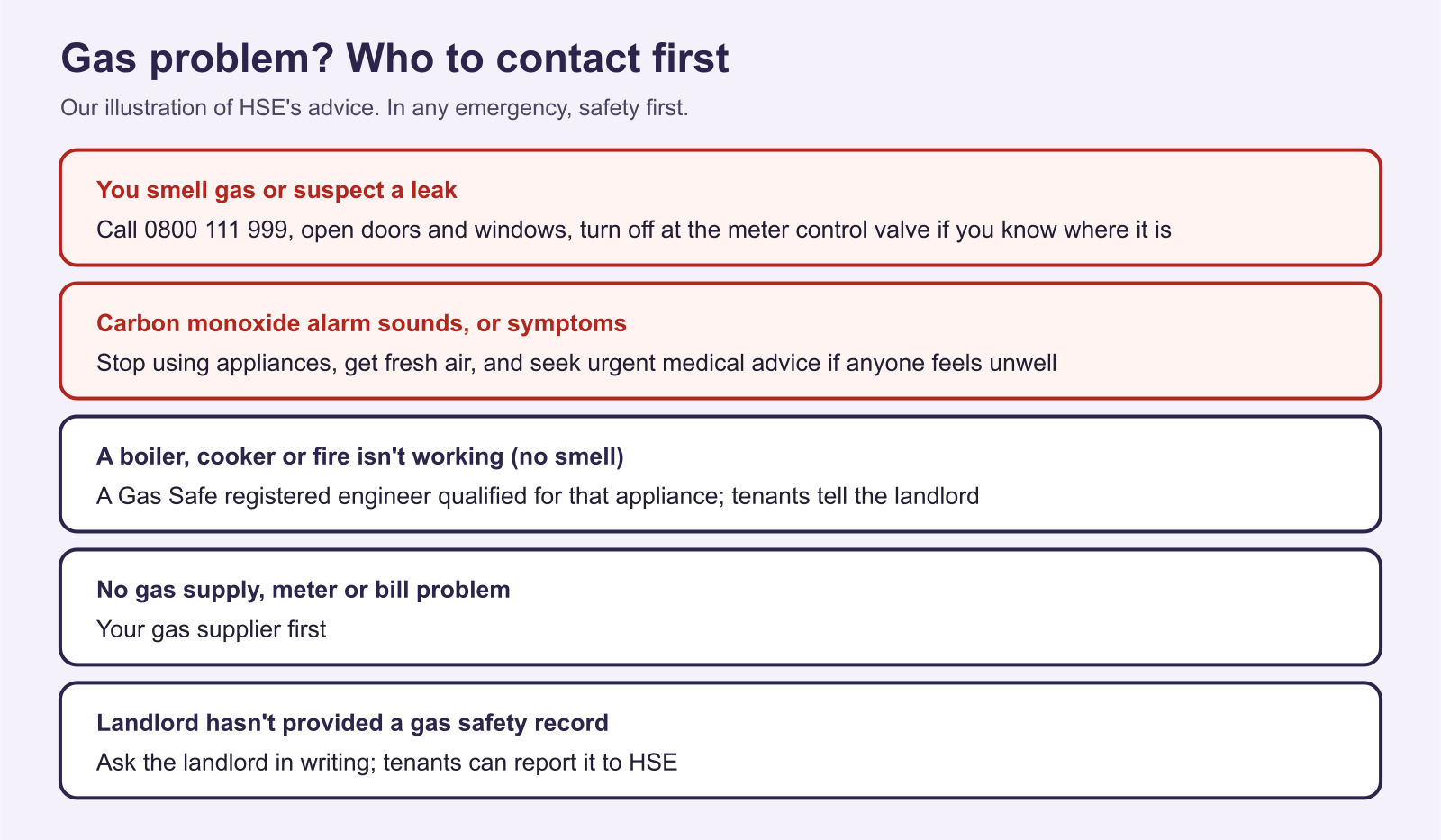
| A smell of gas, inside or outside | Call 0800 111 999 and follow the steps above |
| A carbon monoxide alarm sounding | Stop using appliances, open windows, get outside; seek medical advice if anyone is unwell |
| Boiler not working, no smell | A Gas Safe engineer qualified for boilers; tenants tell the landlord |
| No gas at all, or a meter problem | Your gas supplier |
| An appliance labelled "Danger, Do Not Use" | Don't use it; book a registered engineer to repair or replace |
Carbon monoxide
The gas you can't smell
Natural gas has an added smell so leaks can be noticed. Carbon monoxide, produced when gas burns badly, has none. HSE lists headaches or dizziness, breathlessness, nausea, loss of consciousness, tiredness, pains in the chest or stomach, erratic behaviour and visual problems among the symptoms, and warns they can be mistaken for flu, food poisoning or simple tiredness.
If you or your family have these symptoms and think you may have been exposed, HSE says seek urgent medical advice from your GP or A&E. See carbon monoxide safety.
Be prepared
Five minutes now saves panic later
- Find your gas meter and its control valve, and check you can turn it.
- Save 0800 111 999 in your phone.
- Fit a carbon monoxide alarm near gas appliances, and test it.
- Keep your boiler's make and model, and your last service or gas safety record, somewhere easy to find.
- Know your landlord's or housing provider's emergency contact if you rent.
Afterwards
After a gas emergency: choosing who fixes it
After an emergency it's tempting to book the first engineer who can come. Take a few minutes to check them on the Gas Safe Register, and that their registration covers the appliance. If you're told the appliance must be replaced, ask for the reasons in writing; you're entitled to a second opinion from another registered engineer before agreeing to a replacement. The cost of a proper repair is part of putting the home back in a safe state, not something to cut corners on. See checking an engineer and repair or replace.
Don't let anyone who hasn't been checked restore the gas to an appliance that was capped off. Reconnecting it is gas work, and the original fault may still be there. If you're unsure whether something is safe to use, the answer HSE gives is simple: don't use it until a registered engineer has confirmed it is.
Emergency questions
What number do I call if I smell gas?
The national gas emergency number, 0800 111 999. It’s free and the same across Great Britain.
Should I turn off the gas?
HSE’s advice is to shut off the gas supply at the meter control valve if you know where it is.
Can I keep using the boiler or cooker?
No. HSE says it is illegal for anyone to use a gas appliance they suspect is unsafe.
Who pays for repairs after an emergency visit?
The emergency service makes the situation safe; repairs to your appliances are then for you, or your landlord if you rent, to arrange with a Gas Safe registered engineer.
Sources used on this page
- Domestic gas: frequently asked questions · HSE (3 November 2026)
- Carbon monoxide poisoning · HSE (3 November 2026)
- Landlords’ responsibility for gas safety · HSE (3 November 2026)
A question about gas work in your home?
Tell us what you're trying to sort out. Your message reaches SEO-DONS LTD, the publisher of this guide, and we answer by email. We don't do gas work or recommend engineers, but we can tell you what to check and where. If you smell gas, don't write to us: call 0800 111 999 now.
What happens next
- Your message reaches SEO-DONS LTD, which publishes this guide.
- We reply by email with the rule or check that applies.
- Any work is between you and a Gas Safe registered engineer you choose.