Checking an engineer
Checking a Gas Safe engineer in Liverpool, step by step
Every gas engineer working legally in Liverpool is on the same national register, and checking one takes a couple of minutes. The checks that matter are whether the person is registered, whether the registration is current, and whether it covers the work you need.
Short answer
Gas work in your home must be done by a Gas Safe registered engineer. Ask for the ID card: check the photo, registration number and expiry date on the front and the categories of work on the back. Then look the engineer up on the Gas Safe Register's website. Make sure the categories cover your job.
The law
Why registration isn't optional
HSE, which oversees gas safety in Great Britain, explains that under the Gas Safety (Installation and Use) Regulations 1998, a gas engineering business must be on the Gas Safe Register to legally carry out gas work that falls within the regulations. Gas Safe Register maintains the list of businesses and operatives competent to do both piped natural gas and LPG work, and operates under an agreement with HSE that began on 1 April 2009.
That makes registration the first and simplest test. Anyone employed to work on gas appliances in a home must be a Gas Safe registered engineer and competent in that area of gas work. If someone offers to fit, move, repair or service a gas appliance and can't show registration, the conversation should end there.
The register also polices itself: it has inspectors who check that gas work is being done competently and safely, and HSE says it has a team to track down people working illegally.
Step 1
Ask for the ID card
HSE encourages consumers to ask to see a registered engineer's identity card before any gas work is done in their home. A genuine engineer will expect to be asked.
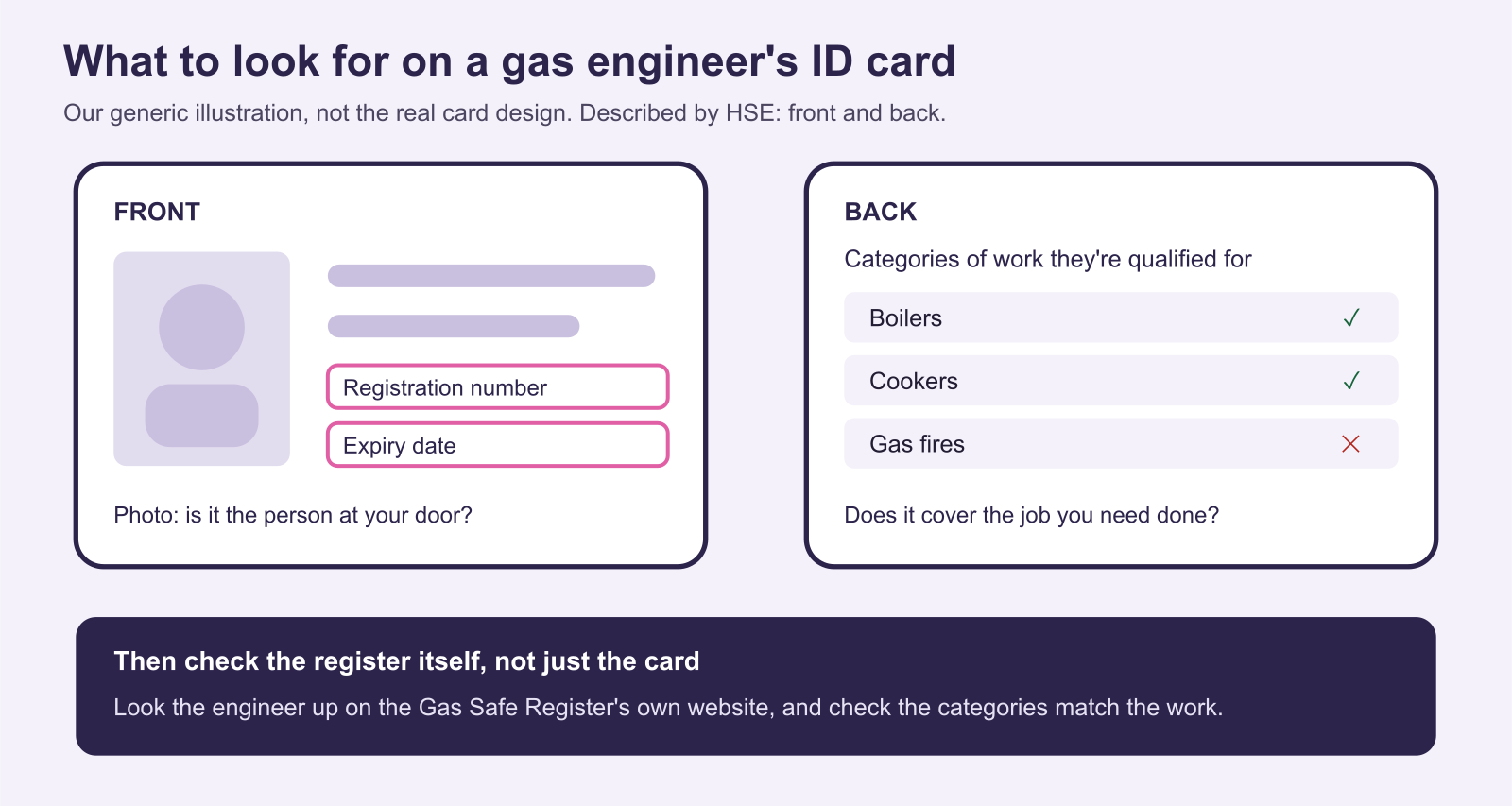
The front has a photograph, a registration number and an expiry date. Check that the photo is of the person in front of you and that the card hasn't expired.
The back lists the categories of work the engineer is qualified to do, for example cookers, boilers and gas fires. This is the check most people miss. If you need a gas fire serviced, the back of the card should show gas fires.
Step 2
Check the register itself
A card can be copied; the register can't. HSE points consumers to the Gas Safe Register's "Check an Engineer" service on its website, which lets you confirm that the engineer who has come to do the work is the one you found. As an extra option, some engineers have signed up to a service that lets you request their photo by text before they arrive.
Check the business, too, if you're booking through a company: the register lists businesses as well as individual engineers. Then check that the categories on the register match the job.
If anything doesn't match, don't let work start. Contact the Gas Safe Register to report it.
The categories
Matching the engineer to the job
| The job | Category to look for | Worth knowing |
|---|---|---|
| Boiler service, repair or replacement | Boilers | Replacement is also notifiable building work; ask how it will be certified |
| Fitting or moving a gas cooker or hob | Cookers | Moving a bayonet-fitted cooker temporarily to clean isn't gas work |
| Gas fire service or fitting | Gas fires | The flue or chimney matters as much as the fire |
| Landlord's annual gas safety check | Every appliance type in the property | All appliances and flues the landlord provides |
| Heat pump or solar panels | Not gas work | Look for MCS certification instead |
Warning signs
When to stop and check again
- No ID card, or reluctance to show it.
- A card that has expired or doesn't show the category of work you need.
- A name or business that doesn't appear on the register.
- Pressure to agree to work on the spot, or a price that only applies if you agree there and then.
- Claims that a gas appliance is dangerous, with an offer to replace it immediately, and no written explanation.
- Requests for full payment upfront in cash.
If an engineer says an appliance is unsafe, ask them to explain in writing and to label it. HSE says an appliance found "at risk" or "immediately dangerous" carries a warning label: Danger, Do Not Use. You're entitled to a second opinion from another registered engineer on whether a replacement is needed; repair or replace lists the questions to ask.
After the visit
What a good engineer leaves you with
Ask for a written record of what was done: the appliance, the work, any defects found and any warning labels applied. For a boiler service, that's a service record; for a landlord's annual check, it's the gas safety record that tenants must receive. For a new boiler, you should also receive confirmation that the installation has been notified under building regulations.
If something goes wrong after the work, contact the engineer first, then the Gas Safe Register about the quality of gas work. Citizens Advice can help with your consumer rights, and since April 2025 misleading sales practices such as false urgency have been banned outright under consumer law.
Beyond gas
Heat pumps, solar and the wrong badge
As more Liverpool homes look at heat pumps and solar, more firms offer both gas and renewable work. Gas Safe registration doesn't cover those technologies: heat pumps and solar panels have their own certification, such as MCS, and grants like the Boiler Upgrade Scheme require an MCS certified installer. A Gas Safe logo next to a heat pump offer tells you nothing about the heat pump. Check each technology against its own register.
Worth the minutes
Two minutes that protect the next ten years
Checking an engineer takes far less time than the work itself, and it decides who you can hold to account if something goes wrong. Treat it as part of booking the job, like agreeing the price. A registered engineer with the right categories, a written record and a clear explanation of any problem is worth more than a cheaper visit you can't trace afterwards.
Checking questions
Is it illegal to use an unregistered gas engineer?
HSE explains that under the Gas Safety (Installation and Use) Regulations 1998, a gas business must be on the Gas Safe Register to do gas work legally. Using an unregistered person puts lives at risk.
What’s on a Gas Safe ID card?
A photograph, a registration number and an expiry date on the front; the categories of work the engineer is qualified for, such as cookers, boilers and gas fires, on the back.
Can I check an engineer online?
Yes. HSE points to the Gas Safe Register’s “Check an Engineer” service, which lets you confirm the engineer who arrives is the one you found. Some engineers also let you request their photo by text.
Does Gas Safe registration cover heat pumps or solar?
No. Gas Safe registration is about gas work. Heat pumps and solar have their own certification, such as MCS.
Can I move my own cooker?
HSE says a free-standing cooker on a flexible bayonet fitting can be moved temporarily, for example to clean behind it. Any other installation or reinstallation is gas work for a registered engineer.
Sources used on this page
- Gas Safe Register and the engineer ID card · HSE (3 November 2026)
- Domestic gas: frequently asked questions · HSE (3 November 2026)
- Gas safety checks: who can do them · HSE (3 November 2026)
- Gas Safety (Installation and Use) Regulations 1998, regulation 36 · legislation.gov.uk (3 November 2026)
- Building regulations approval: when you need it · GOV.UK (3 November 2026)
- Find a certified installer · MCS (3 November 2026)
- DMCC Act 2024, Schedule 20 (banned practices) · legislation.gov.uk (2 November 2026)
- Scams · Citizens Advice (3 November 2026)
A question about gas work in your home?
Tell us what you're trying to sort out. Your message reaches SEO-DONS LTD, the publisher of this guide, and we answer by email. We don't do gas work or recommend engineers, but we can tell you what to check and where. If you smell gas, don't write to us: call 0800 111 999 now.
What happens next
- Your message reaches SEO-DONS LTD, which publishes this guide.
- We reply by email with the rule or check that applies.
- Any work is between you and a Gas Safe registered engineer you choose.